How AI is Transforming Website & App Development in 2026
A few short years ago, artificial intelligence sounded like an experimental trend reserved for massive tech companies. Now, it operates as a core component of the daily workflow for development teams worldwide. Teams rely on AI tools for developers to speed up coding, guide complex design decisions, and understand user behavior on a deeper level.
The result is highly tangible for business owners and creators. We are seeing faster project delivery, superior performance, and digital products that actually match what users want to experience. If you run a business or plan to build a digital platform, understanding how AI fits into this process is no longer optional. It directly impacts your costs, your product quality, and your overall growth trajectory.
This guide will walk you through exactly how AI is reshaping the creation of digital products. You will learn about the rise of AI workflows, its role in coding and design, the massive benefits it offers, and the practical steps your business can take to integrate these technologies successfully.
The Rise of AI in Development Workflows
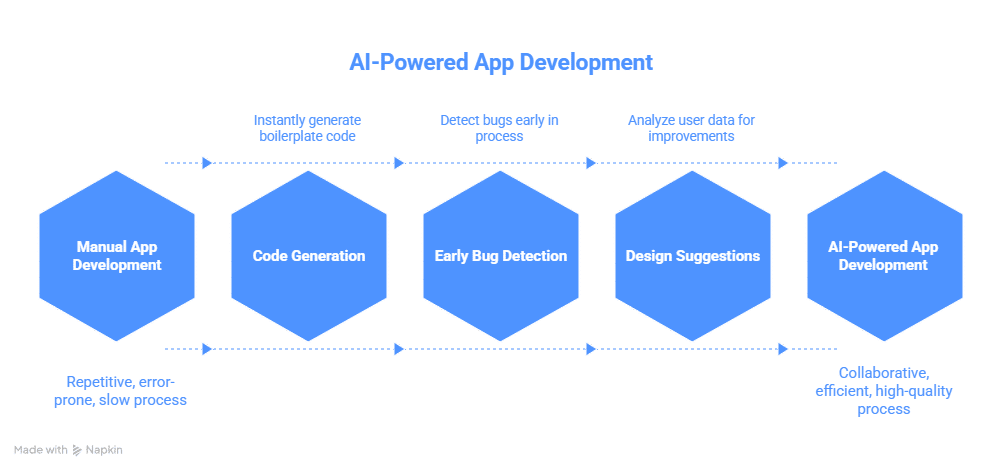
Building a website or application has fundamentally changed from a purely manual grind to a collaborative mix of human expertise and machine intelligence. Developers still make the critical architectural and strategic decisions, but AI now handles the heavy lifting of repetitive tasks, code suggestions, and deep testing.
Machine learning and automation tools weave directly into the modern developer's environment. Teams use these systems to generate boilerplate code snippets instantly. This helps developers reduce manual typing and maintain strict consistency across massive project files without sacrificing quality.
Furthermore, these tools detect bugs exceptionally early in the building process. Teams can spot and fix logic issues before they become complex, tangled, and expensive to resolve closer to launch. AI also analyzes real user interaction data to suggest layout and design improvements. Because of this massive shift, smart businesses actively seek out AI-powered app development solutions to stay competitive and agile.
Key Ways AI is Changing Development in 2026
The integration of artificial intelligence impacts every single phase of the software lifecycle. Here is exactly how AI is changing the way we build digital experiences.
Faster Coding with AI Assistance
Modern AI tools for developers act like a highly skilled co-pilot sitting right next to the programmer. These tools help developers write code much quicker by predicting lines, suggesting functions, and fixing syntax errors in real time. They do not replace human engineers. Instead, they eliminate the tedious, repetitive work that causes fatigue.
In practical terms, this dramatically speeds up turnaround times. Developers finish basic coding tasks faster and dedicate their energy to delivering a polished final product. You see far fewer basic coding mistakes because the software continuously highlights necessary corrections. This allows developers to focus heavily on complex features, performance optimization, and advanced security logic. For businesses, this translates into cost-effective and rapid product launches.
Better UI/UX Decisions Using Data
Design decisions no longer rely on guesswork, gut feelings, or fleeting visual trends. We now use AI to study exactly how people interact with a website or application, allowing the software to suggest data-backed improvements.
For instance, machine learning algorithms can identify exactly where users stop scrolling on a webpage. This helps developers understand content placement issues and restructure layouts to keep visitors reading. AI also highlights which buttons or navigation elements get ignored. Teams can then redesign those specific calls-to-action for much better visibility and interaction rates. By using behavioral data to suggest structural changes, AI-driven design drastically improves session durations and reduces bounce rates.
Real Personalization (Not Just Customization)
Modern users expect websites and applications to feel highly relevant to their specific needs. AI makes true personalization possible by analyzing individual behavior and serving custom content dynamically. This goes far beyond basic customization where a user manually selects a dark mode or a preferred language.
E-commerce platforms now use AI to offer product suggestions based on browsing history, previous purchases, and highly specific user preferences. This directly increases sales and customer satisfaction. Applications also feature personalized dashboards that display relevant updates and tools tailored to how an individual actually uses the software. When businesses invest in AI in website development to personalize the user journey, they consistently see better engagement and higher return visits.
Smarter Systems: Chatbots, Testing, and Insights
Beyond writing code and designing interfaces, AI fundamentally changes how we test software, support users, and plan for the future.
AI Chatbots for Everyday Support
Customer support requires speed and efficiency, and AI chatbots deliver exactly that. Modern conversational agents can answer complex questions, guide users through complicated workflows, and even handle basic sales tasks.
These bots remain available around the clock to handle customer queries. Users receive support without frustrating delays, regardless of their time zone. Instant replies improve the overall user experience by providing quick solutions to common problems. This significantly reduces the support workload for your human teams. Your staff can focus on high-level customer relationship building while the AI handles the massive volume of routine queries.
Smarter Testing and Bug Detection
Quality assurance and software testing used to consume massive amounts of manual effort and time. Now, intelligent tools scan thousands of lines of code in seconds, detect hidden issues, and even predict exactly where performance bottlenecks might occur under heavy load.
This predictive testing helps teams fix bugs much earlier in the cycle. Small issues get resolved before they turn into major structural problems. Automating the testing process reduces launch delays and ensures a much smoother deployment day. Continuous performance monitoring also detects security vulnerabilities before they ever affect your end users.
Predictive Insights for Better Decisions
Artificial intelligence does not just react to what is happening right now. It predicts what will happen next. By analyzing historical data, AI helps businesses understand what their users might do in the future.
These systems can predict purchase behavior by looking at past interaction data. This helps marketing and sales teams plan highly effective, targeted campaigns. AI also identifies precise drop-off points in the user journey. Once you know exactly where visitors abandon your app, you can fix those specific pages to reduce churn. This allows leadership teams to make practical, data-driven decisions instead of relying on assumptions.
The Tangible Benefits of AI-Powered App Development
Adopting these technologies brings massive advantages to companies of all sizes. The most obvious benefit is faster delivery. Projects move quicker from the planning phase to the final launch because developers automate the repetitive work.
You also gain significantly better cost control. Less time spent on manual coding and manual bug hunting directly reduces your overall development budget. Furthermore, personalization and smarter design decisions create smoother user journeys. Optimized layouts and highly targeted content naturally help turn casual visitors into paying customers, resulting in higher conversion rates. Finally, AI systems ensure easy scalability. Your application can handle sudden spikes in traffic and user growth without suffering from major performance crashes.
Navigating the Challenges of AI Integration
While the benefits are massive, integrating artificial intelligence does present a few practical challenges. Businesses must navigate these hurdles carefully to see a strong return on investment.
First, the initial setup can require a solid financial investment. Small businesses need to budget for premium tools, infrastructure upgrades, and the skilled professionals required to implement these solutions correctly. You still need highly skilled developers to manage, customize, and monitor the AI systems. The tools act as an assistant, not an autonomous replacement for a senior engineering team.
Data privacy also requires extremely careful handling. AI systems rely heavily on collecting and processing user data to function properly. Businesses must ensure strict compliance with security standards and regional data protection laws. Working with experienced development partners helps mitigate these risks entirely.
Practical Steps for Businesses to Use AI Effectively
If you plan to build a new digital product or upgrade an existing one, you need a clear strategy. Simply throwing AI tools at a project will not guarantee success. Here are practical steps to effectively leverage these technologies.
Choose AI-powered app development solutions that align directly with your specific business goals. Ensure the technology you adopt actually supports your long-term scalability rather than just serving as a temporary gimmick.
Always focus on mobile-first design. Ensure your platform performs flawlessly on smartphones, as the vast majority of users access digital services through mobile devices today.
Implement robust analytics tools from day one. Use these platforms to understand user behavior deeply, which will guide your future decisions regarding feature updates and content placement. Add conversational chatbots strictly where customer interaction adds value, ensuring users get instant support when they need it most.
Finally, optimize your platform for both traditional text search and voice queries. As more users rely on voice-activated assistants, building voice search capabilities into your digital products ensures you capture that growing audience.
Conclusion
Artificial intelligence has completely rewritten the rules for how we build digital products. It speeds up the entire engineering process, vastly improves the end-user experience, and empowers business leaders to make decisions backed by hard data.
For companies operating in 2026, the question is no longer if you should use AI, but how quickly and effectively you can integrate it into your operations. If you are planning a new software project, taking the time to understand and leverage AI tools for developers will make a massive difference.
Work closely with professionals who understand this modern landscape. By combining human strategy with machine efficiency, you will build scalable, high-performing digital platforms that drive real business growth.